Outdoor and garden
How to Sharpen Lawn Mower Blades
- 1 h
- Easy
- 7 steps
- 10 tools
- 2 parts
Snap yours and Mechy redraws these steps for it. First guide free, no sign-up.
Short answer
Take the blade off a walk-behind rotary mower, file both edges evenly along the original angle, check it hangs level, then bolt it back the right way up at the torque in your manual. About 1 hour for a first-timer.
Safety first
DIY friendlyDo these before step 1.
- DANGERPull the spark plug wire off the plug first (battery mower: take the battery out). A blade that turns can cut you badly.
- WARNINGTip the mower with the air filter and carburetor facing UP, as the manual says, or run the tank empty first. Fuel and oil must not leak.
- WARNINGWear thick gloves and eye protection. Blade edges are sharp, and filing throws metal dust.
- WARNINGKeep the mower steady when tipped. Do not lean on it or let it fall while you pull on the wrench.
- WARNINGNever reuse a bent or cracked blade, and never straighten one. It can break and throw pieces.
- NOTICEDo not overheat the blade when grinding. Use light passes with pauses. A blue color means the metal has gone soft. Do not quench it in water.
- NOTICEUse the torque in your mower's manual or on its label. If you cannot find it, ask a dealer.
Stop and call a pro or the dealer if
- The blade is cracked, bent, or worn thin near the center. Replace it, do not repair it.
- The blade bolt is rounded off, seized, or the mower shaft looks bent. Take it to a dealer.
- The mower shakes badly after refitting, which can mean a bent shaft or damaged mounting.
- You cannot find the torque value in the manual. Ask a dealer, do not guess.
Mechy's guides help, but they don't replace the maker's manual, your training or your site's rules. If something doesn't match what you see, stop and check.
Tools
Tick what you have. In the app, Mechy ticks the ones it can see in your photos.
Parts and supplies
- 1×Replacement blade (only if bent, cracked or worn thin)Match the mower's make, model and blade length, from the manualCheck before you buy
- 1×Blade bolt and washer (replace if damaged)Match the original, from the manual or the dealerCheck before you buy Size chart
Steps
-
Step 1 of 7
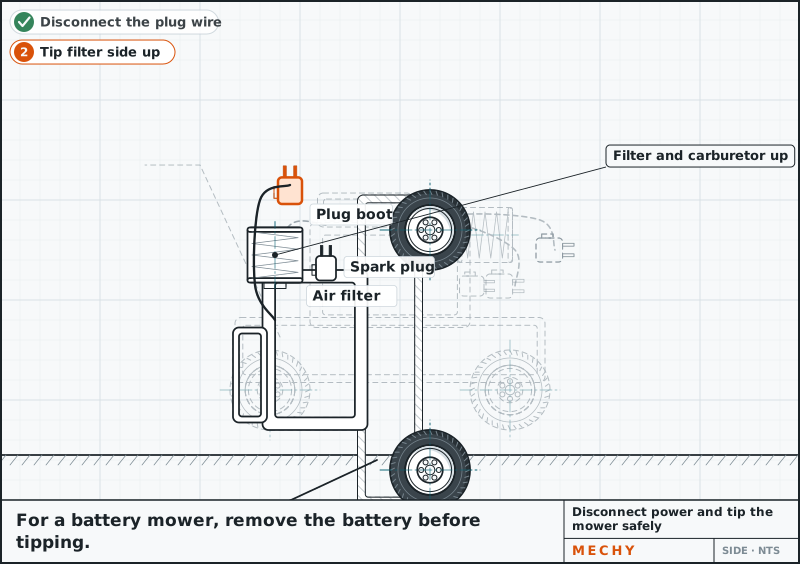
Disconnect power and tip the mower safely
Pull the spark plug wire off the plug and tuck it away so it cannot touch the plug. On a battery mower, take the battery out. Tip the mower on its side with the air filter and carburetor facing up, or run the tank empty first.
Never work on the blade with the plug wire or battery connected.
Thick work gloves
-
Step 2 of 7
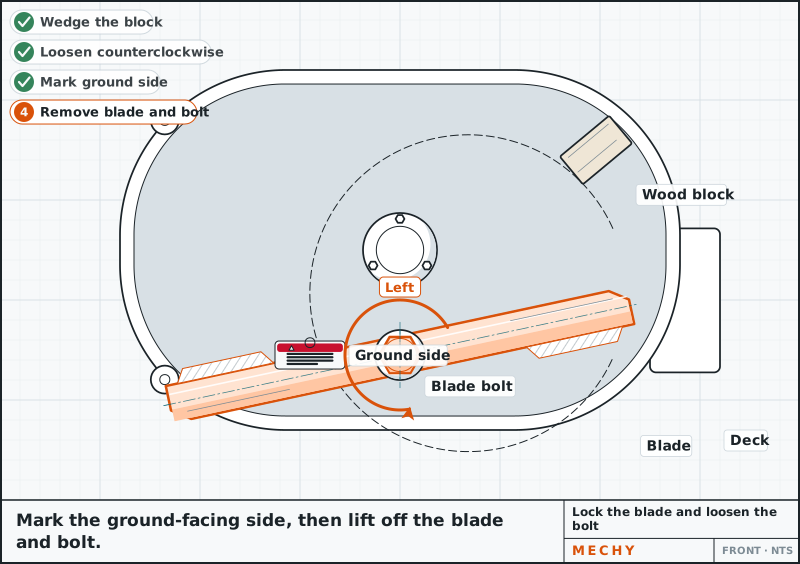
Mark, lock and remove the blade
Mark the side of the blade that faces the ground. Wedge the wood block between one end of the blade and the deck so it cannot turn. Fit the socket on the bolt and turn it counterclockwise (left). Lift the blade off.
Stand so your hand cannot slip into the blade if the wrench jumps.
Bolt direction: Counterclockwise (usual; check manual) Check it against your manual.
Block of wood, Socket wrench with extension, Marker or paint pen, Thick work gloves
-
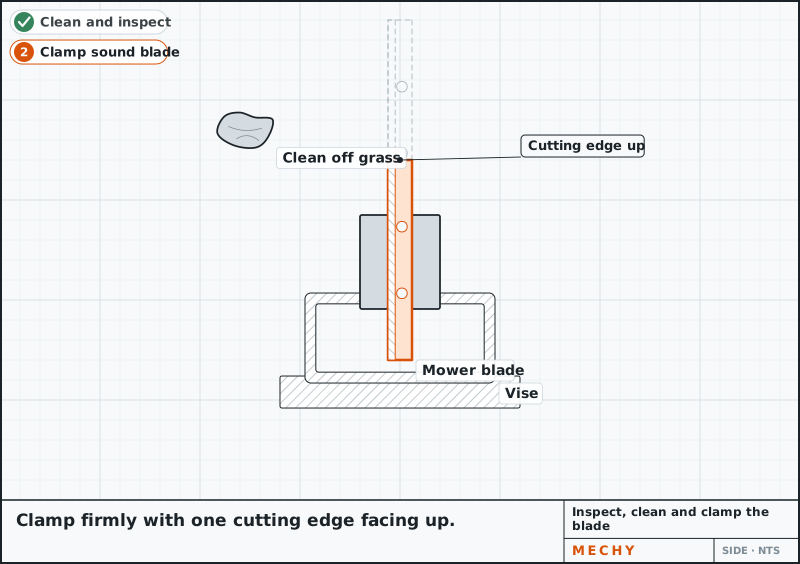
Step 3 of 7
Inspect, clean and clamp the blade
Brush off grass. Look for cracks, bends or thin worn spots. If you find any, throw it away and fit a new blade. If it is sound, clamp it in the vise with one cutting edge facing up.
A bent or cracked blade can break and throw pieces. Do not repair it. Replace it.
Wire brush and rag, Bench vise, Thick work gloves
-
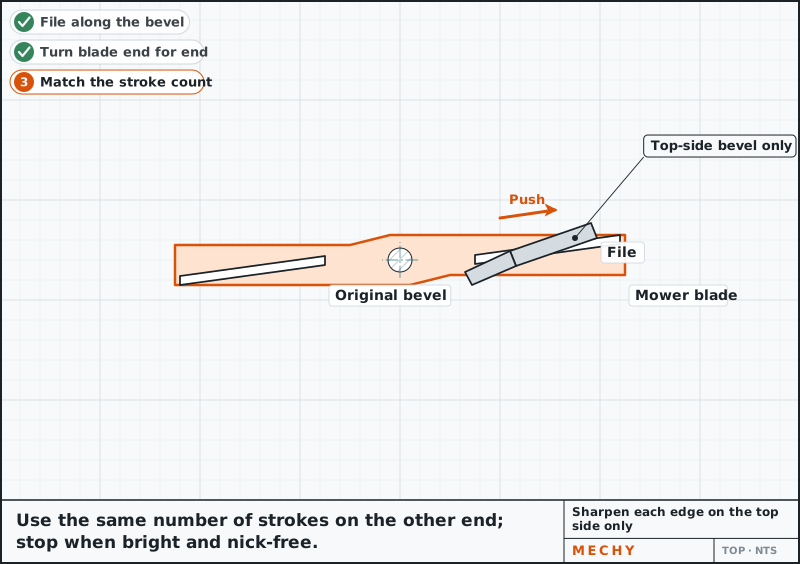
Step 4 of 7
Sharpen each edge on the top side only
Push the file along the original bevel (the slanted edge) in one direction, away from you. Use the same number of strokes on each end. Stop when the nicks are gone and the edge looks bright. A grinder works too, in light passes.
Keep the original angle. Do not make it razor thin. Do not overheat it; a blue color means it is ruined.
Flat mill file or bench grinder, Bench vise, Thick work gloves, Eye protection
-
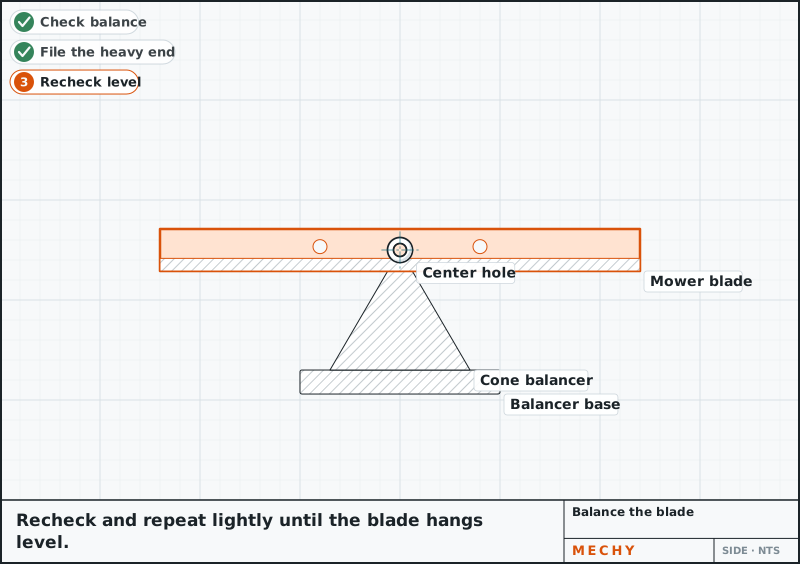
Step 5 of 7
Balance the blade
Hang the blade by its center hole on the nail or cone balancer. The end that dips is heavy. File a little metal off the very end of that side (many manuals say the tip of the curved wing), never near the center, until it hangs level.
An unbalanced blade shakes the mower and can damage the engine.
Blade balancer or a nail, Flat mill file or bench grinder
-
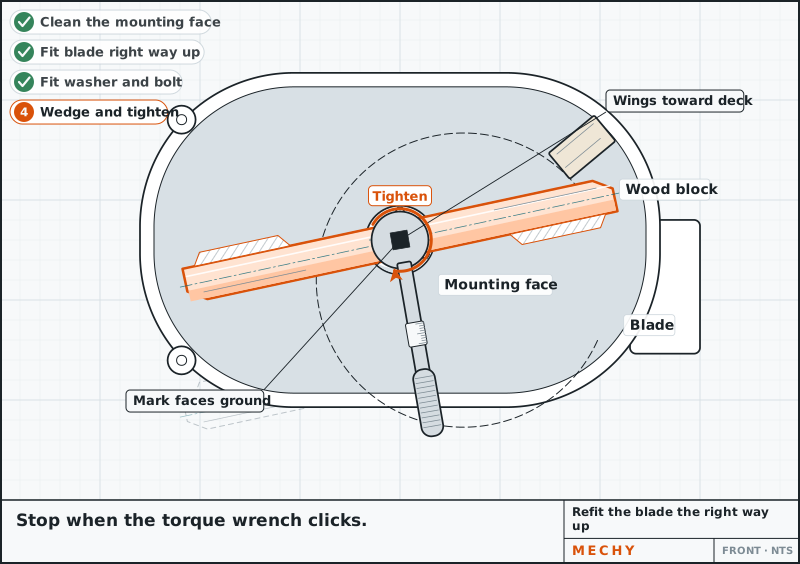
Step 6 of 7
Refit the blade the right way up
Clean the mounting face. Put the blade on with your mark facing the ground, so the curved wings point up toward the deck. Fit the washer and bolt, wedge the wood block again, and tighten to the torque in your manual.
A blade fitted upside down will not cut and can be thrown.
Blade bolt torque: From your mower's manual Check it against your manual.
Socket wrench with extension, Torque wrench, Block of wood
-
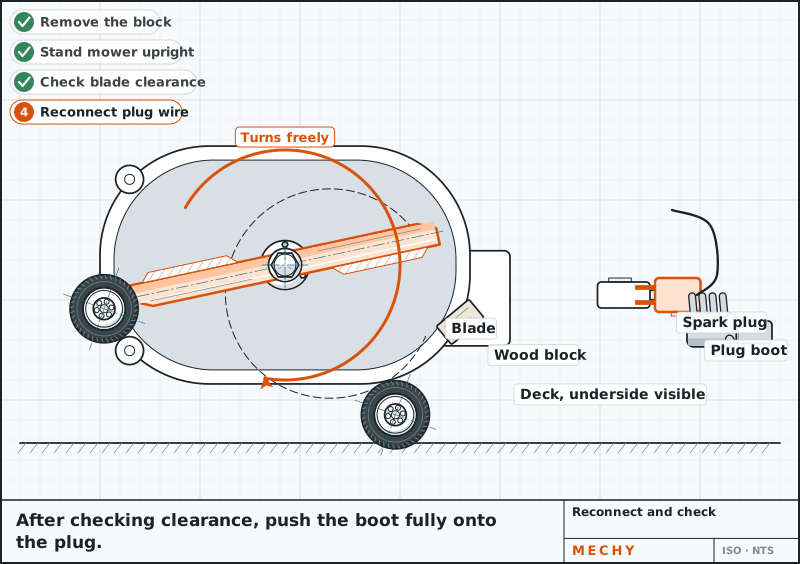
Step 7 of 7
Reconnect and check
Remove the wood block and stand the mower upright. With the plug wire still off, spin the blade by hand to check it clears the deck. Push the wire onto the plug or refit the battery. Run it briefly; stop if it shakes. Recheck the bolt after the first mow.
Keep hands and feet clear of the deck when you start the mower.
Socket wrench with extension


Common mistakes
- Leaving the spark plug wire connected while working on the blade.
- Tipping the mower with the carburetor down so fuel or oil leaks into the engine.
- Overheating the blade while grinding until it turns blue and goes soft.
- Skipping the balance check, which makes the mower shake.
- Fitting the blade upside down or guessing the bolt torque.
Questions
How often should I sharpen my lawn mower blade?
Check it at the start of each season and again if the grass looks torn or ragged. Heavy use or sandy soil dulls blades faster.
Can I sharpen a mower blade without taking it off?
It is not advised. You cannot reach the edge safely or check balance, and the blade can move. Remove it.
Do I need to balance a mower blade after sharpening?
Yes. An uneven blade makes the mower shake, which wears the engine and shaft. A nail or cone balancer shows which end is heavy.
Which way does the mower blade go on?
The curved wings point up toward the deck, and the side you marked faces the ground.
Should I tip the mower with the carburetor up or down?
Usually up: tip it so the air filter and carburetor face up, unless your manual says otherwise. Tipped the wrong way, oil and fuel can run into the air filter and carburetor.
Sources
Updated
Not quite the same? Snap yours.
Mechy looks at your photo and redraws the steps for what you actually have.
First guide free. No sign-up, no card.
Related guides