
Check engine light · EVAP
EVAP system leak: what it means and where to look
Your car’s fuel vapor system failed its leak test; most leaks are the cap, a valve or a hose.
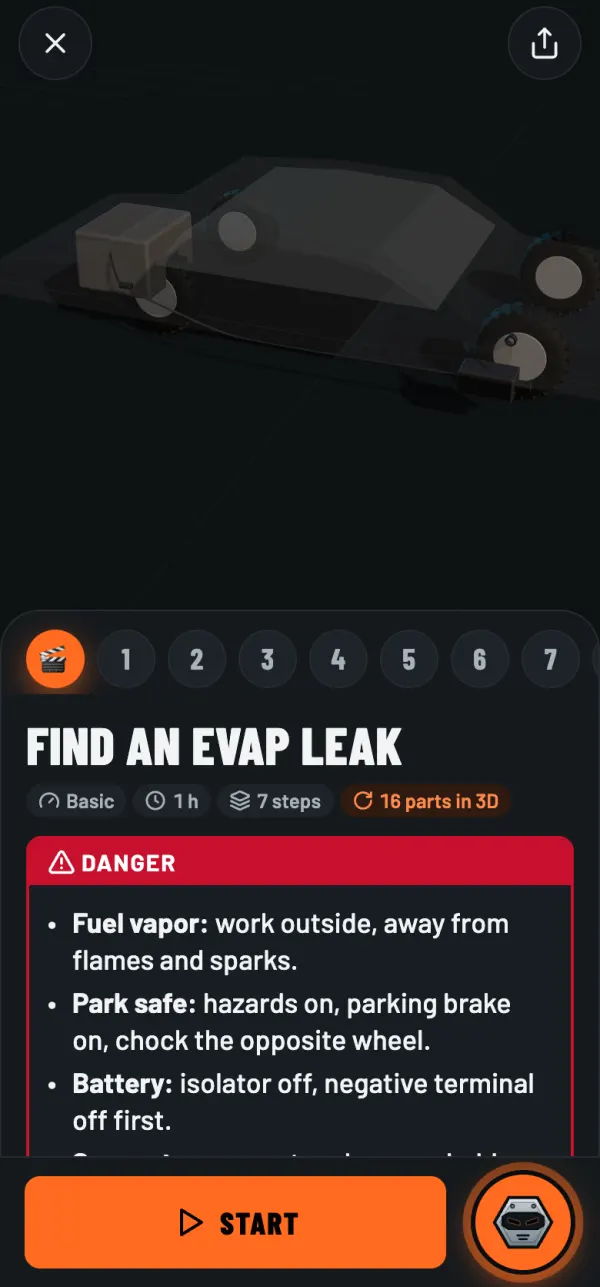
Short answer
An EVAP system leak means the car sealed its fuel vapor system, ran a leak test and found it couldn’t hold vacuum. It isn’t an engine fault, and most cars drive normally with it. The usual causes, cheapest first: a loose or worn gas cap, a split vapor hose, a stuck purge or vent valve, then the canister or filler neck.
- What leaksFuel vapor from the tank, canister, valves and hoses
- CodesP0440, P0442, P0455, P0456, P0457 (leaks); P0441, P0443, P0446, P0449, P0496, P0497 (valves)
- Smallest leak it findsA 0.020-inch hole, CARB rule since 2003 models
- Check firstThe gas cap: seal, threads, a click
- Shop prices$138 (cap) to $643 (canister), RepairPal, Nov 21, 2026
Can I drive with an EVAP leak?
Usually yes, fix it soonRepairPal rates every EVAP code “moderate”: not an immediate threat, but get it diagnosed in a reasonable time (RepairPal). It won’t pass an OBD emissions inspection with the light on (EPA). Stop and get help if you smell raw fuel or see it drip: gasoline vapor is flammable and harmful to breathe (Toyota owner’s manual), and KBB’s advice with fumes is to drive straight to a mechanic (KBB).
What is the EVAP system, and how does it find a leak?
The EVAP system keeps gasoline vapor from the tank out of the air. Vapor collects in a charcoal canister; once the engine is warm, the computer opens the purge valve and the engine draws that vapor in and burns it (Snap-on). A vent valve at the canister lets fresh air in behind it, and on most cars it’s open until the computer closes it (Innova).
To test for leaks, the computer closes the vent valve, opens the purge valve to pull a little vacuum on the tank, shuts it again and watches the tank pressure sensor: if the vacuum decays too fast, or never builds on two tests in a row, it fails the system (RepairPal). Some Toyotas run their check with the engine off, about five hours after you park, and you may hear it under the car (Toyota owner’s manual).
Which EVAP code do you have, and what does it point to?
Your EVAP code tells you which part of the test failed: a leak (P0440, P0442, P0455, P0456, P0457), the purge side (P0441, P0443, P0496, P0497), the vent side (P0446, P0449) or the tank pressure sensor (P0451–P0453). Leak codes need a search; circuit codes are electrical and say nothing about a leak (Snap-on).
| Code | What the car reports | What it usually means | Check first |
|---|---|---|---|
| P0440 | Evaporative Emission System (older lists: “Control System Malfunction”) | A general EVAP fault; some makers set it for a large leak | Gas cap, then the hoses you can see |
| P0441 | Incorrect Purge Flow | Too much or too little vapor flow while purging | Purge valve holding vacuum unpowered |
| P0442 | Leak Detected (small leak) | A small leak, larger than P0456’s | Cap seal, then hoses; smoke test if hidden |
| P0443 | Purge Control Valve Circuit | An electrical fault, not a leak | Purge valve connector and wiring (see the purge valve page) |
| P0446 | Vent Control Circuit | The vent valve or its circuit doesn’t respond | Vent valve and its filter near the tank |
| P0449 | Vent Valve/Solenoid Circuit | An electrical fault in the vent valve | Vent valve connector and wiring (see P0446) |
| P0451 | Pressure Sensor/Switch (range/performance) | Tank pressure readings out of spec during the test | Tank pressure sensor and its plug |
| P0452 | Pressure Sensor/Switch Low | Tank pressure sensor reads below spec | Sensor connector and wiring |
| P0453 | Pressure Sensor/Switch High | Tank pressure sensor reads above spec | Sensor connector and wiring |
| P0455 | Leak Detected (large leak) | The system can’t build vacuum at all | Cap on and clicked; vent valve stuck open |
| P0456 | Leak Detected (very small leak) | A leak in the 0.020-inch class | Cap seal; then a smoke test |
| P0457 | Leak Detected (fuel cap loose/off) | The car decided the leak is the cap | Cap: seal, threads, click |
| P0496 | High Purge Flow | Purging when it shouldn’t: valve stuck open | Purge valve (see the purge valve page) |
| P0497 | Low Purge Flow | Not purging when it should | Purge valve and its lines (see the purge valve page) |
No EVAP code on this list matches. Codes use a zero, not the letter O; any code works in Mechy’s box above.
Names: the SAE J2012 wording as RepairPal prints it (older lists say “Evaporative Emission Control System”, OBD-Codes.com, Delaware DMV). “Check first” is the cheapest check that rules the most out, from the sources on this page. Checked November 21, 2026.
What are the symptoms of an EVAP leak?
The main symptom of an EVAP leak is the check engine light, often with nothing else: RepairPal says that in most cases the driver notices no change (RepairPal). The others, when they show:
- A cap message first on some cars: “CHECK FUEL CAP” on a Honda, “TIGHTEN GAS CAP” on a Chevrolet (Honda, GM).
- A fuel smell around the car or the fuel door (RepairPal).
- A little more fuel used with a large leak (KBB).
- A hard start or rough idle right after refueling, when the purge valve is stuck open (Snap-on UK).
- Trouble filling the tank, when the vent valve is stuck closed (Innova).
Where is an EVAP leak usually found?
An EVAP leak is usually at one of five places, and three of them sit near the tank, under the back of the car:
- Gas cap and filler neck. A cap that isn’t clicked, a cracked seal, or dirt on a capless flap. RepairPal lists a missing or loose cap first for P0455, ahead of a damaged filler neck (RepairPal); see the loose gas cap page for how long the light takes to go off.
- Vapor hoses and fittings between the tank, the canister and the engine bay: cracked rubber, a loose quick-connect, or a line hit from below.
- Vent valve at the canister near the tank, low on the car where dust, water and road salt reach it; Snap-on calls a dirty vent valve one of the most frequent causes (Snap-on).
- Purge valve in the engine bay, between the canister line and the intake (Bosch). One stuck slightly open can look like a small leak (Snap-on).
- Canister and tank. A cracked canister, or a rusted filler neck or tank seam, are the expensive end.
What can you check yourself, and what needs a smoke test?
You can check an EVAP leak’s cheap causes yourself (the cap, the hoses you can see and the valves); a hidden leak needs a smoke test. Mechy doesn’t plug into the car or read codes (what Mechy does and doesn’t do): read the code with any OBD-II scanner, then type it with your car into Mechy and it builds the checks as steps.
- Read and write down every code and its freeze frame before you clear anything.
- Cap or capless inlet: wipe the seal, look for cracks, and fit it until it clicks. Honda’s manual says to tighten it “until it clicks at least once” (Honda CR-V manual).
- Hoses you can reach: trace them at the canister, the tank and the engine bay for splits and loose fittings.
- Purge valve: unpowered, it should hold vacuum; RepairPal’s test is 30 to 60 seconds of steady vacuum (RepairPal).
- Vent valve: a scan tool that can command it closed shows whether it seals; a bad one often won’t hold vacuum when activated (Samarins).
A smoke test is the shop’s way to find a hidden leak: the vent valve is commanded closed, the system is filled at a low 11 to 14 inches of water (0.47 psi), and the tech follows the smoke under the car with a light (Redline Detection). Don’t tighten the cap before the test if you can help it: a shop that tests after the cap was fixed finds no leak (MOTOR via Maryland MDE).
How much does it cost to fix an EVAP leak?
Fixing an EVAP leak costs from nothing (a cap that wasn’t clicked) to over $600 for a canister at a shop, checked November 21, 2026. Diagnosis is often the first bill, and the same parts cost far less on their own.
| Repair | US price (source) |
|---|---|
| Emission system diagnosis and testing | $61–$90 (RepairPal) |
| Check engine light diagnosis and testing | $125–$183 (RepairPal) |
| Gas cap, aftermarket part only | $5.40 (Motorad MGC829), $6.86 (Stant 10829) (RockAuto) |
| Gas cap replacement at a shop | $138–$150 (RepairPal) |
| Purge valve, aftermarket part only (a GM fit) | $23.79 (Wells 2M1077) (RockAuto) |
| Purge valve replacement | $210–$251 (RepairPal) |
| Vent valve, aftermarket part only | $47.79 (Dorman 911-519, GM), $72.79 (Dorman 911-760, Honda) (RockAuto) |
| Vent solenoid, two examples | $182 (2011 Dodge Nitro), $304 (2014 BMW 328i xDrive) (YourMechanic) |
| Fuel tank pressure sensor replacement | $356–$457 (RepairPal) |
| Charcoal (EVAP) canister replacement | $558–$643 (RepairPal) |
Checked November 21, 2026. RepairPal ranges are its national shop estimates, parts and labor, and its parts look like dealer prices. YourMechanic and RockAuto quote one car or one part at a time, so their rows are examples, not averages. None lists a separate price for a smoke test.
How long does it take, and when does the light go off?
The repair itself is short: Mechy’s ten EVAP jobs in this cluster run from 15 minutes (a gas cap) to 1 h 30 min (a P0455 or P0442 search). The light takes longer. Honda says the light should go off “after several days of normal driving” once the cap is tightened or replaced (Honda CR-V manual), and Toyota says “after several driving trips” (Toyota owner’s manual).
The EVAP leak test runs only when conditions line up, so it doesn’t happen on every drive. RepairPal says the car must have sat for four to eight hours so the engine and air temperatures match, with the tank between 15 and 85 percent full (RepairPal); California’s rule lets makers skip the test above 85 percent or while refueling (CARB 13 CCR 1968.2). AA1Car adds that very cold or very hot weather (below 0 °F, above 90 °F) can hold it off too (AA1Car).
What is the difference between a small, very small and large EVAP leak?
A large, small and very small EVAP leak differ by the size of hole the car’s test can catch, and each has its own code.
The leak sizes come from the OBD II rules. California requires the system to flag leaks that add up to a 0.040-inch hole (about 1 mm) and, separately, a 0.020-inch hole (about half a millimeter) (CARB 13 CCR 1968.2); the 0.020-inch check phased in from 20 percent of 2000 models to all 2003 models (CARB 13 CCR 1968.1). The federal rule for 2017 and later cars uses the same 0.020-inch size and names P0456 as a “very small leak” code (EPA, 40 CFR 86.1806-17).
P0455 is the “large leak” code: the system couldn’t build vacuum at all, the way it fails with the cap off (RepairPal). P0457 is the cap-specific version some makers set when they can tell it’s the cap (Saab WIS).
Will an EVAP leak fail inspection or hurt the engine?
An EVAP code fails an emissions inspection: under the federal rule a car fails the OBD test if the check engine light is commanded on for any stored code (EPA, 40 CFR 85.2207). Clearing the code just before the test doesn’t help either: 2001 and newer cars may have at most one monitor “not ready” (EPA, 40 CFR 85.2222), and the EVAP monitor only runs now and then, so EPA’s guidance is to drive normally for about a week after a repair before you test (EPA420-R-01-015).
It won’t hurt the engine in most cases: KBB says a car with P0455 drives as usual, only wasting more fuel (KBB). The exception is a purge valve stuck open, which can run the engine rich; OBD-Codes.com says that can cause damage over time (OBD-Codes.com). Vapor that escapes is lost gas: a widely repeated estimate from 2000, later quoted by the Car Care Council, put 17 percent of US cars’ caps as damaged, loose or missing and 147 million gallons a year vaporized (The Auto Channel, 2000, Car Care Council).
Does an EVAP leak look different on a Honda, Toyota, Chevy or Ford?
An EVAP leak is the same fault on every make, but each maker warns you differently and clears the light on its own schedule:
| Make | What the source says |
|---|---|
| Honda | A “CHECK FUEL CAP” message first; retighten until it clicks at least once and the light should go off after several days of normal driving. (CR-V 2009 manual) |
| Toyota | Runs an engine-off leak check about five hours after you park; the light goes off after several trips, and a stored code needs 40 or more drives to clear by itself. (Camry manual) |
| Chevrolet, GMC | A “TIGHTEN GAS CAP” message; turn the cap until it clicks, and a few trips should turn the light off. The wrong cap can light it too. (Equinox 2014 manual) |
| Ford (capless) | No screw cap: a “Check Fuel Fill Inlet” message, which may take several drive cycles to go off; driving on can bring on the service engine soon light. (Flex 2015 manual) |
| Subaru-built | P0457 (cap loose or off) sets after two drive cycles in a row with the fault; the listed symptoms are a fuel odor and a loose or missing cap. (Saab 9-2X manual) |
| Mazda 6 2.5 L (built Sept 2009 to May 2011) | Spider webs blocked the vent line near the valve; Mazda safety and emissions recall 7214C. (Snap-on) |
Checked November 21, 2026. One model’s manual or one parts listing per make; yours may differ.
What did Mechy’s ten EVAP jobs have in common?
We ran Mechy’s engine on ten EVAP problems from this cluster (one per page, each on a real model) and read what it built. The pattern is the order a shop works in:
- 8 of 10 start by reading the codes and freeze frame before clearing anything.
- 8 of 10 put the cap or filler in the first three steps.
- 7 of 10 send a hidden leak to a shop smoke test rather than guessing at parts.
- All 10 end by checking the fix held after the system retests, and all 10 say to stop if you smell or see fuel.
- They took 13 to 17 seconds to build, with 6 or 7 steps each.
The jobs are on each code’s page, word for word, with the app’s own screens.
What does Mechy build for an EVAP leak on a 2016 Honda Civic?
We typed a scanner’s “EVAP system leak detected” message for a 2016 Honda Civic into New job, the way a reader of this page would, with no photo and no code number. This is what came back.
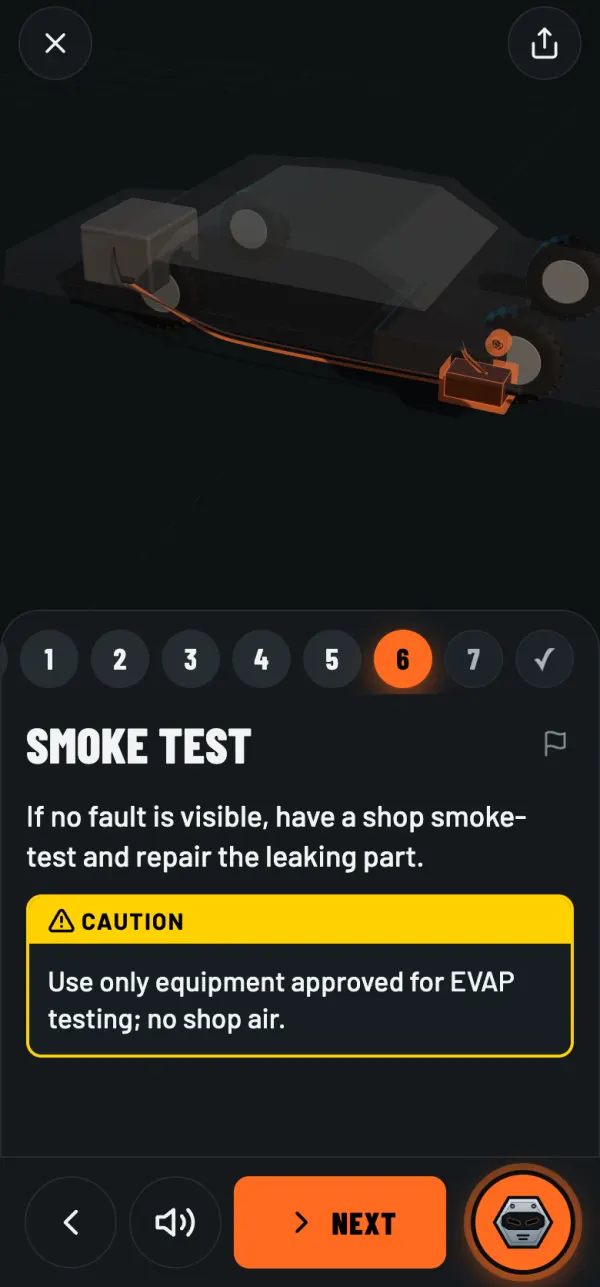
Typed into New job“2016 Honda Civic. Check engine light is on and the scanner says EVAP system leak detected. How do I find the leak?”
- Park safely. Park outside, set the brake, switch off, and keep ignition sources away.
- Record the codes. Read and save all codes and freeze-frame data before clearing anything.
- Inspect filler seal. Check the capless inlet flap and seal for dirt or damage; wipe gently.
- Trace vapor lines. Inspect accessible hoses and connectors for splits, looseness, or damage.
- Check valves. Inspect the purge and vent valves and wiring; test per the service manual.
- Smoke test. If no fault is visible, have a shop smoke-test and repair the leaking part.
- Verify repair. Clear codes after repair; drive until the EVAP monitor runs and recheck.
Tools it listed: OBD-II scanner, Flashlight, Inspection mirror, Clean rag. Parts: EVAP hose or seal.
When it says to stop:
- Call a pro if you smell strong fuel or see liquid fuel leaking.
- Use a shop if the leak is inaccessible or requires a smoke test.
Mechy’s own engine built this on November 21, 2026 from the words above and no photo, the same call the app makes when you tap Analyze job. A mechanic hasn’t checked it line by line, and your car’s service manual wins where they differ.
Have the code?
Questions
How long does an EVAP leak take to fix?
From a minute (clicking the cap on) to an hour or two for a valve or hose; Mechy’s ten EVAP jobs run 15 minutes to 1 h 30 min. The light can take several days of normal driving to go off after the fix, because the leak test only runs under set conditions.
Can a loose gas cap cause an EVAP leak code?
Yes. A loose or missing cap is the first cause RepairPal lists for P0455, and some cars set P0457 when they can tell the leak is the cap. Tighten it until it clicks and drive normally for a few days.
Will an EVAP code clear itself?
Often, if the cause is gone: the light goes off after the system passes its own test on a later drive, which Honda puts at several days of normal driving. If it comes back, the leak is still there.
Can I find an EVAP leak without a smoke machine?
Sometimes: check the cap and seal, trace the hoses you can reach, test the purge valve with a hand vacuum pump, and have a scan tool command the vent valve closed. A leak you can’t see needs a smoke test.
Does an EVAP leak affect gas mileage?
A little: vapor that escapes is gas you paid for. KBB notes a large leak wastes more fuel, but the car itself runs the same.
Sources
- RepairPal, P0455 OBD-II code: meaning, common causes, severity (read 2026-11-21)
- U.S. EPA, 40 CFR § 85.2207 On-board diagnostic test standards (eCFR)
- Toyota Camry Owner’s Manual OM33A33U: fuel tank cap, malfunction indicator lamp, I/M test, evaporation leakage check
- Kelley Blue Book, P0441 (read 2026-11-21)
- Snap-on, EVAP system operation (October 1, 2025)
- Innova, Common Symptoms of a Faulty EVAP Canister Vent Valve (updated July 13, 2026)
- RepairPal, P0441 OBD-II code: meaning, diagnostic theory, leak test conditions (read 2026-11-21)
- OBD-Codes.com, P0400–P0499 code list (read 2026-11-21)
- Delaware Division of Motor Vehicles, On-Board Diagnostic Trouble Codes list (2004)
- Honda CR-V 2009 Owner’s Manual: fuel fill cap, CHECK FUEL CAP message, refueling
- Chevrolet Equinox 2014 Owner Manual: TIGHTEN GAS CAP message, fuel cap, malfunction indicator lamp
- Kelley Blue Book, P0455 (read 2026-11-21)
- Snap-on UK, Evaporative Emission Control System (EVAP)
- Bosch Auto Parts, Canister Purge Valves
- Samarins.com, EVAP vent valve (solenoid): how it works, problems, testing
- Redline Detection, SpeedSmoke Operations Manual: How to diagnose EVAP leaks (October 2020)
- Maryland Department of the Environment, RepairCare: Vapor Trails (MOTOR, 2006 excerpt)
- RepairPal, Emission System Diagnosis & Testing Cost (updated September 3, 2026; read 2026-11-21)
- RepairPal, Check Engine Light Diagnosis & Testing Cost (updated September 3, 2026; read 2026-11-21)
- RockAuto, fuel tank caps: Stant 10829 and Motorad MGC829, part only (read 2026-11-21)
- RepairPal, Gas Cap Replacement Cost Estimate (updated September 3, 2026; read 2026-11-21)
- RockAuto, vapor canister purge valve: Wells 2M1077 for GM, part only (read 2026-11-21)
- RepairPal, Purge Valve Replacement Cost Estimate (estimates updated September 3, 2026; read 2026-11-21)
- RockAuto, vapor canister vent valve: Dorman 911-519 for GM, part only (read 2026-11-21)
- YourMechanic, Evaporation Vent Solenoid Replacement: price by car (read 2026-11-21)
- RepairPal, Fuel Tank Pressure Sensor Replacement Cost Estimate (updated September 3, 2026; read 2026-11-21)
- RepairPal, Fuel Evaporative Canister Replacement Cost Estimate (updated September 3, 2026; read 2026-11-21)
- California Air Resources Board, 13 CCR § 1968.2, OBD II requirements for 2004 and later vehicles, section (e)(4) evaporative system monitoring (Cornell LII copy)
- AA1Car (Carley Automotive), Loose gas cap: when the EVAP self-test runs
- California Air Resources Board, 13 CCR § 1968.1, OBD II requirements for 1994 and later vehicles: the 0.020-inch phase-in (Cornell LII copy)
- U.S. EPA, 40 CFR § 86.1806-17 Onboard diagnostics (eCFR, amended April 18, 2024)
- Saab WIS 9-2X 2005 (Subaru-built), DTC P0457 Evaporative Emission Control System Leak Detected (Fuel Cap Loose/Off)
- U.S. EPA, 40 CFR § 85.2222 On-board diagnostic test procedures: unset readiness monitors (eCFR)
- U.S. EPA, Performing Onboard Diagnostic System Checks as Part of a Vehicle Inspection and Maintenance Program, EPA420-R-01-015 (June 2001)
- OBD-Codes.com, P0496 (read 2026-11-21)
- The Auto Channel, Putting A Lid On Bad Gas Caps (October 5, 2000): the 17 percent and 147 million gallon estimate
- Car Care Council gas-saving tips, via The Auto Channel (June 12, 2003)
- Ford 2015 Flex Owner’s Manual, page 195: Easy Fuel capless filler, Check Fuel Fill Inlet message (ManualsLib copy)
Updated · By Mechy (Winding AI, Inc.) · How we write these pages · Checked November 21, 2026