
OBD-II code · EVAP
P0456 code: very small EVAP leak
A leak about half a millimeter across: cheap to fix once found, and finding it is the work.
Short answer
P0456 means “Evaporative Emission System Leak Detected (very small leak)”: the car found a vapor leak down to the size of a 0.020-inch hole. The car runs the same. Start with the gas cap seal, then the hoses and the purge valve; a leak you can’t see needs a smoke test.
- CodeP0456, Evaporative Emission System Leak Detected (very small leak)
- Leak size0.020-inch hole, about half a millimeter (EPA, CARB)
- Drivable?Yes; RepairPal rates it moderate
- DIY time45 min for Mechy’s checks, smoke test at a shop
- Diagnosis$61–$90 emission system testing (RepairPal, Nov 21, 2026)
Can I drive with P0456?
Yes, fix it soonA very small vapor leak doesn’t change how the engine runs; RepairPal rates P0456 moderate, to be diagnosed in a reasonable time (RepairPal). It still fails an emissions inspection while the light is on. Stop and get help if you smell raw fuel or see it drip: gasoline vapor is flammable and harmful to breathe (Toyota owner’s manual), and KBB’s advice with fumes is to drive straight to a mechanic (KBB).
What does the P0456 code mean?
P0456 means the EVAP leak test found the smallest kind of leak the rules ask for. EPA’s rule for 2017 and later cars says the system must catch a leak “at or above 0.020 inches” and store a code “specific to an EVAP system very small leak (e.g., P0456…)” (EPA, 40 CFR 86.1806-17).
That is about half a millimeter. California set the same two checks earlier, a 0.040-inch and a 0.020-inch hole (CARB 13 CCR 1968.2), and its 0.020-inch check phased in from 20 percent of 2000 models to all 2003 models (CARB 13 CCR 1968.1), so most cars from 2003 on can set P0456. P0442 is the larger “small leak” code and P0455 the large one.
What are the symptoms of P0456?
P0456 usually has no symptom but the check engine light: in most EVAP faults the driver notices no change (RepairPal). Some notice a fuel smell, which RepairPal lists among the less common EVAP symptoms. The light may also come and go, because very-small-leak tests don’t run on every drive (see below).
Why is a P0456 leak so hard to find?
A P0456 leak is hard to find because the hole can be as small as 0.020 inch, and the car may only test for it on some drives. California lets very-small-leak monitors take “up to twelve driving cycles on average” before they light the lamp (CARB 13 CCR 1968.2), which is why the light can come and go.
Two things fool the search. A purge valve stuck slightly open can mimic a small leak (Snap-on). And tightening the cap before a shop’s test can hide the leak you came in for (MOTOR via Maryland MDE).
What causes P0456?
P0456 is most often a worn or dirty gas cap seal; the rest are pinholes in hoses, valves and seals:
- Gas cap seal worn, cracked or dirty, or a capless flap that doesn’t close fully.
- Purge valve leaking slightly closed (Snap-on: leaking purge valves and dirty vent valves are the most frequent causes in modern systems).
- Vent valve or its filter fouled with dust or salt, so it doesn’t seal during the test.
- Hoses and O-rings: hairline cracks at fittings.
- Canister or filler neck: a cracked canister or a rust pinhole.
How do you diagnose P0456?
You diagnose P0456 cheapest-first, and the smoke test comes earlier than for other codes. Mechy doesn’t plug into the car or read codes (what Mechy does and doesn’t do): read the code with any OBD-II scanner, then type it with your car into Mechy and it builds the checks as steps.
- Record the codes and freeze frame; don’t clear yet.
- Inspect the cap or capless inlet; replace a cap with a cracked seal.
- Look over the hoses you can reach for splits and loose fittings.
- Test the purge valve: unpowered it should hold vacuum 30 to 60 seconds (RepairPal).
- Smoke test: the shop closes the vent with a scan tool, fills the system at 11–14 inches of water and follows the smoke (Redline Detection).
- Repair, then let the system retest over several days of normal driving.
How much does it cost to fix P0456?
P0456 usually costs a diagnosis plus a small part; the expensive end is a canister.
| Repair | US price (source) |
|---|---|
| Emission system diagnosis and testing | $61–$90 (RepairPal) |
| Check engine light diagnosis and testing | $125–$183 (RepairPal) |
| Gas cap, aftermarket part only | $5.40 (Motorad MGC829), $6.86 (Stant 10829) (RockAuto) |
| Gas cap replacement at a shop | $138–$150 (RepairPal) |
| Purge valve, aftermarket part only (a GM fit) | $23.79 (Wells 2M1077) (RockAuto) |
| Purge valve replacement | $210–$251 (RepairPal) |
| Vent solenoid, two examples | $182 (2011 Dodge Nitro), $304 (2014 BMW 328i xDrive) (YourMechanic) |
| Charcoal (EVAP) canister replacement | $558–$643 (RepairPal) |
Checked November 21, 2026. RepairPal ranges are its national shop estimates, parts and labor, and its parts look like dealer prices. YourMechanic and RockAuto quote one car or one part at a time, so their rows are examples, not averages. None lists a separate price for a smoke test.
Is a very small EVAP leak worth fixing?
Yes, a P0456 leak is worth fixing if your state inspects, because the light alone fails the test (below). If not, it’s still worth a cap and a look, because the light that stays on hides the next fault behind it.
An EVAP code fails an emissions inspection: under the federal rule a car fails the OBD test if the check engine light is commanded on for any stored code (EPA, 40 CFR 85.2207). Clearing the code just before the test doesn’t help either: 2001 and newer cars may have at most one monitor “not ready” (EPA, 40 CFR 85.2222), and the EVAP monitor only runs now and then, so EPA’s guidance is to drive normally for about a week after a repair before you test (EPA420-R-01-015).
Which makes get P0456, and what do they show?
Any car built to the 0.020-inch rule can set P0456, so it isn’t one maker’s problem; what differs is the warning and how fast the light clears:
| Make | What the source says |
|---|---|
| Ford (capless) | No screw cap: a “Check Fuel Fill Inlet” message, which may take several drive cycles to go off; driving on can bring on the service engine soon light. (Flex 2015 manual) |
| Chevrolet, GMC | A “TIGHTEN GAS CAP” message; turn the cap until it clicks, and a few trips should turn the light off. The wrong cap can light it too. (Equinox 2014 manual) |
| Honda | A “CHECK FUEL CAP” message first; retighten until it clicks at least once and the light should go off after several days of normal driving. (CR-V 2009 manual) |
| Toyota | Runs an engine-off leak check about five hours after you park; the light goes off after several trips, and a stored code needs 40 or more drives to clear by itself. (Camry manual) |
Checked November 21, 2026. One model’s manual or one parts listing per make; yours may differ.
How can you prevent P0456 from coming back?
You prevent P0456 mostly at the pump. Click the cap every time, and stop at the nozzle’s first click: Honda’s manual says not to top off (Honda CR-V manual), and AAA says overfilling can push liquid fuel into the vapor parts and flood the charcoal canister (AAA Club Alliance).
What does Mechy build for P0456 on a 2018 Ford Escape?
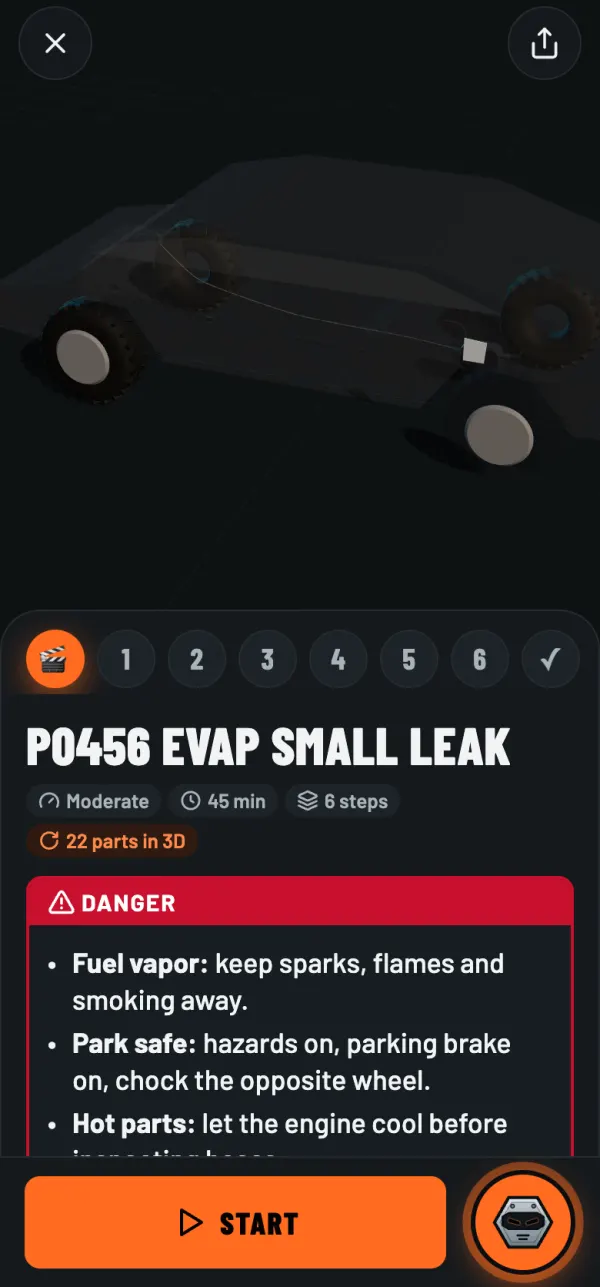
Mechy built this P0456 guide from the car and the code typed into New job, as a reader of this page would, with no photo.
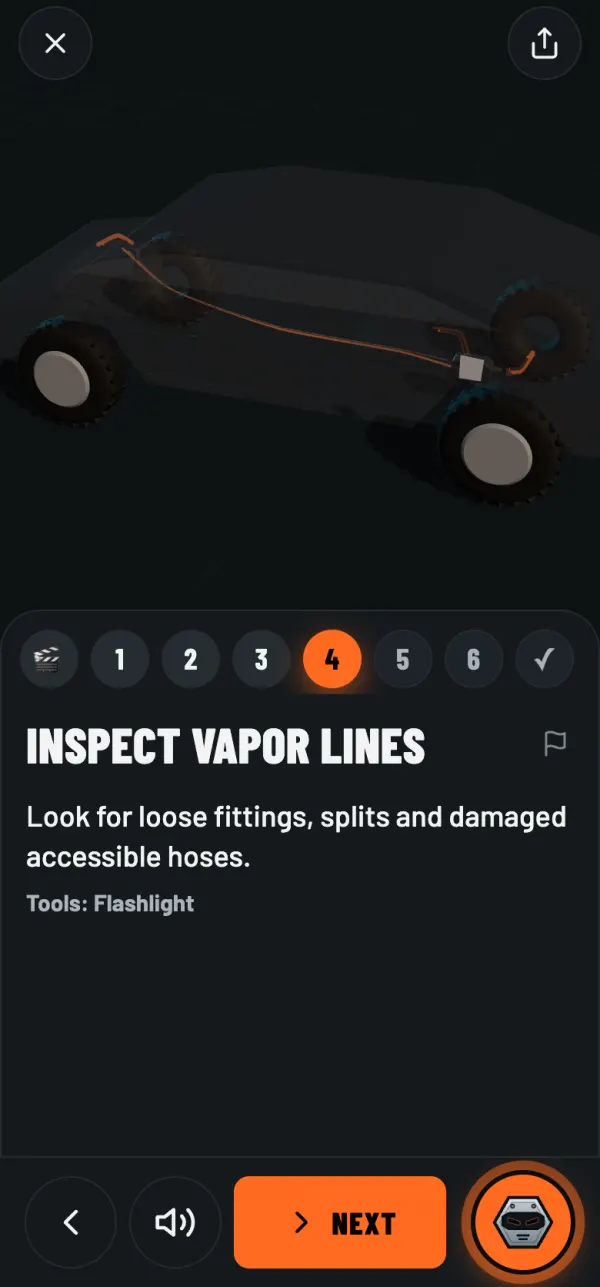
Typed into New job“2018 Ford Escape. Fault code P0456.”
- Park safely. Park outside, set the brake, switch off and let the engine cool.
- Read the codes. Record codes and freeze-frame data before clearing anything.
- Check filler seal. Inspect the capless inlet and flap; wipe accessible dirt away.
- Inspect vapor lines. Look for loose fittings, splits and damaged accessible hoses.
- Pinpoint the leak. Have a shop smoke-test the sealed system and test the purge valve.
- Repair and verify. Repair the confirmed leak; clear codes and check after a drive cycle.
Tools it listed: OBD-II scanner, Flashlight, Clean lint-free cloth. Parts: EVAP repair parts.
When it says to stop:
- Call a pro if fuel is leaking or vapor smell is strong.
- Use a shop if the leak is inaccessible or needs a smoke test.
Mechy’s own engine built this on November 21, 2026 from the words above and no photo, the same call the app makes when you tap Analyze job. A mechanic hasn’t checked it line by line, and your car’s service manual wins where they differ.
Got P0456 on your car?
Questions
How much does it cost to fix a P0456 code?
Often under $100 for testing plus a small part. RepairPal puts emission system testing at $61–$90 and a gas cap at $138–$150 at a shop; a canister is $558–$643. Checked November 21, 2026.
Can P0456 go away on its own?
It can turn off after the system passes its test again, and very-small-leak tests can take many drives, so it may come and go. If it keeps coming back, the leak is real.
Is P0456 the gas cap?
Often it is the cap seal, so start there. If a new cap doesn’t stop it, the next suspects are a leaking purge valve, the vent valve and small hose cracks.
What is the difference between P0456 and P0442?
Size. P0442 is the small-leak code; P0456 is the very small one, which EPA ties to a 0.020-inch hole. Both are searched the same way.
Sources
- RepairPal, P0456 OBD-II code (read 2026-11-21)
- Toyota Camry Owner’s Manual OM33A33U: fuel tank cap, malfunction indicator lamp, I/M test, evaporation leakage check
- Kelley Blue Book, P0441 (read 2026-11-21)
- U.S. EPA, 40 CFR § 86.1806-17 Onboard diagnostics (eCFR, amended April 18, 2024)
- California Air Resources Board, 13 CCR § 1968.2, OBD II requirements for 2004 and later vehicles, section (e)(4) evaporative system monitoring (Cornell LII copy)
- California Air Resources Board, 13 CCR § 1968.1, OBD II requirements for 1994 and later vehicles: the 0.020-inch phase-in (Cornell LII copy)
- RepairPal, P0441 OBD-II code: meaning, diagnostic theory, leak test conditions (read 2026-11-21)
- Snap-on, EVAP system operation (October 1, 2025)
- Maryland Department of the Environment, RepairCare: Vapor Trails (MOTOR, 2006 excerpt)
- Redline Detection, SpeedSmoke Operations Manual: How to diagnose EVAP leaks (October 2020)
- RepairPal, Emission System Diagnosis & Testing Cost (updated September 3, 2026; read 2026-11-21)
- RepairPal, Check Engine Light Diagnosis & Testing Cost (updated September 3, 2026; read 2026-11-21)
- RockAuto, fuel tank caps: Stant 10829 and Motorad MGC829, part only (read 2026-11-21)
- RepairPal, Gas Cap Replacement Cost Estimate (updated September 3, 2026; read 2026-11-21)
- RockAuto, vapor canister purge valve: Wells 2M1077 for GM, part only (read 2026-11-21)
- RepairPal, Purge Valve Replacement Cost Estimate (estimates updated September 3, 2026; read 2026-11-21)
- YourMechanic, Evaporation Vent Solenoid Replacement: price by car (read 2026-11-21)
- RepairPal, Fuel Evaporative Canister Replacement Cost Estimate (updated September 3, 2026; read 2026-11-21)
- U.S. EPA, 40 CFR § 85.2207 On-board diagnostic test standards (eCFR)
- U.S. EPA, 40 CFR § 85.2222 On-board diagnostic test procedures: unset readiness monitors (eCFR)
- U.S. EPA, Performing Onboard Diagnostic System Checks as Part of a Vehicle Inspection and Maintenance Program, EPA420-R-01-015 (June 2001)
- Ford 2015 Flex Owner’s Manual, page 195: Easy Fuel capless filler, Check Fuel Fill Inlet message (ManualsLib copy)
- Chevrolet Equinox 2014 Owner Manual: TIGHTEN GAS CAP message, fuel cap, malfunction indicator lamp
- Honda CR-V 2009 Owner’s Manual: fuel fill cap, CHECK FUEL CAP message, refueling
- AAA Club Alliance, Is It Bad to Top Off Your Gas Tank? (April 23, 2026)
Updated · By Mechy (Winding AI, Inc.) · How we write these pages · Checked November 21, 2026